

I recently finished a paper for my graduate program on managing transitions well within an organization. At first I didn’t think there would be much to glean, after all, I am a self employed writer, and have for the past ten years primarily been a stay at home mom. I don’t actually run or oversee any team, or do I?
As I flipped through the pages of our required readings, it hit me. Leading a family is one of the hardest and most important roles in our society! Formal organizations are built upon traditional family systems like mine. And with this change in perspective, I was able to begin viewing the material differently.
Bestselling authors William and Susan Bridges clearly denote the difference between a change and a transition:
“Transition is very different from change. Change is situational: the
reduction in the work force, the shift in the strategy, and the switch in report-
ing relationships are all “changes.” Transition, on the other hand, is a three-
phase psychological reorientation process that people go through when they
are coming to terms with change. It begins with an ending—with people
letting go of their old reality and their old identity.”
My oldest daughter turns 10 this Fall. We have been planning a get- away, just her and I, to mark the milestone together. While she is approaching many changes, I love the differentiation marked by a transition.
In one article, Bridges wrote “unless people can make a real ending, they will be unable to make a successful beginning.”
I began to wonder, how am I helping my daughter make a real ending? How am I supporting her as she says goodbye to her childhood, and approaches her tween years? Am I holding her back in areas because I am not ready to see her grow up? Or am I nudging her towards gently closing the door on who she once was and ushering her towards the young woman God is calling her to become?
I know many of you are busy, and likely unable to run out and buy these books on organizational change or workplace transitions! But I did feel there was much information that could be applicable, so I put together a small “guide” for you below. You will see that it reflects the story of Moses leading the Israelites out of Egypt, through the wilderness, and the transition into the promised land.
This comprehensive, spiritually-grounded resource is designed to help you help your daughter transition from childhood to the teen years — modeled after the transformational and practical style of William Bridges’ Getting Them Through the Wilderness. This resource focuses on the emotional, spiritual, and practical transitions involved in this key life phase.
Guiding Her Through the Transition Years
Like the Israelites leaving Egypt for the Promised Land, your daughter is leaving the innocence and simplicity of childhood for the vast, unfamiliar terrain of adolescence. This journey isn’t just about physical or emotional growth—it’s a spiritual pilgrimage. As a mom, you are both guide and fellow traveler, navigating with grace, wisdom, and trust in God.
Overview Structure
Modeled after Bridges’ 3-phase framework of transition — Ending, Wilderness, New Beginning — this guide is broken into three key parts.
PART 1: Leaving Childhood (The Ending Phase)
Objective: acknowledge the end of childhood and honor it with grace and patience.
Key Topics to keep in mind during this phase:
- Recognizing the Signs: Mood swings, curiosity, need for more independence, and questions about identity, body changes, beauty, social standards.
- Grieving What Was: Saying goodbye to childhood without fear or clinging to what once was.
- Celebrating the Past: spend time reminiscing about her former years!
- Letting Go as a Mom: Surrendering control while still offering guidance. Leaning on adult friends who have done this before you, or reaching out to a trusted therapist to responsibly manage your own feelings that arise. Be sure you are doing your own “work” and not unloading this responsibility onto her.
- Biblical Anchor: Ecclesiastes 3:1 – “To everything there is a season…”
Reflection & Activities to consider:
- Mother-Daughter Journal Prompts- start a shared journal that you can use to write to each other. At night leave your entry in the journal on her bed, and ask that she writes back to you for the morning.
- Letter-writing exercise: “What I’ll Miss About Childhood” – spend some time encouraging her to reflect upon her childhood, acknowledging what she may miss (or already misses!)
- Prayer – begin to speak boldly and confidently about the young woman she is becoming. Remind her that this transition is normal, and is a part of God’s plan for her! Look at the past with gratitude, and the future with hopeful expectancy!
PART 2: The Wilderness (The Neutral Zone)
Objective: walk daughters through the confusing middle space — the season between girlhood and womanhood. Often this is a time that is either rushed through or avoided (like mothers who try to hold their girls back or keep them little).
Key Topics to keep in mind during this phase:
- Notice Body + Mental Health Changes: between the ages of 9-12 girls tend to have an increase in anxiety, depression and body dissatisfaction. This is normal. Consider walking with her through this book.
- Dealing with Emotions & Mental Health Biblically: remind her it’s okay to have big emotions, but we have to learn to manage them in God honoring ways. I really love the work of Sissy Goff for this!
- The Role of Friendships & Social Media: help her establish healthy friendships with other girls! Many aren’t on social media yet, and long for in person time together. If she is on social media, please set healthy limits and know that her time there is not a replacement for in real life relationships. Try to facilitate in person hang outs as much as possible.
- Your New Role- From Manager to Mentor: your influence changes as she gets older. Kari Kampakis writes about this in her book Love Her Well if you’d like to dive in a bit deeper.
- How to Guide Without Controlling: I recently read a quote (author unknown) that said “if your peace depends on everything going right, it’s not peace, its control. Learn to be steady in uncertainty by leading on the Lord.” Our girls don’t need us controlling their every move, they need us guiding them through this time of uncertainty.
- Faith in the Wilderness: Helping Her Make Faith Her Own– I tell my girls often that they can’t borrow my faith, but have to spend time developing their own relationship with their Savior. While I don’t leave them to “figure it out” on their own, I am also mindful that I don’t baby them in this area. It will take some pain and tension for the deep roots of their faith to be established. In moments where she feels lost, confused, or overwhelmed, remind her that she has a solid foundation that she can always return to, and that won’t always be you.
- Biblical Anchor: Isaiah 43:19 – “See, I am doing a new thing!”
Reflection & Activities to consider:
- Monthly “Wilderness Walks” – create space and plan time for walks together outside. If unavailable, consider time together in the car to intentionally connect over topics related to her transition
- Begin a Devotional Series together like this one
- “Ask Me Anything” Hour: Creating space for awkward or tough conversations by naming it something fun can help ease the weird energy that comes from often tough and sticky topics.
I know this is a lot of information, which is why I wanted to break it into two parts. In the next newsletter I will share tips on how to help your girl transition from the neutral phase and into the “new promised land” of her tween/teen years. These years are so important as you have the opportunity to help her embrace her womanhood with Christ at the center of her identity. Stay tuned!
Free Guide to Assertive Communication
If you are a fellow people pleaser, someone who struggles with speaking your opinions clearly, or has learned along the way that your needs aren’t as important as others – know that you are not alone.
Assertive communication can feel so uncomfortable at first. It may also come as a shock to those around you, and you may have concerns about what they will think. We are going to dive into untangling all of the myths you have surrounding assertiveness and talk about why it serves both us and those around us.
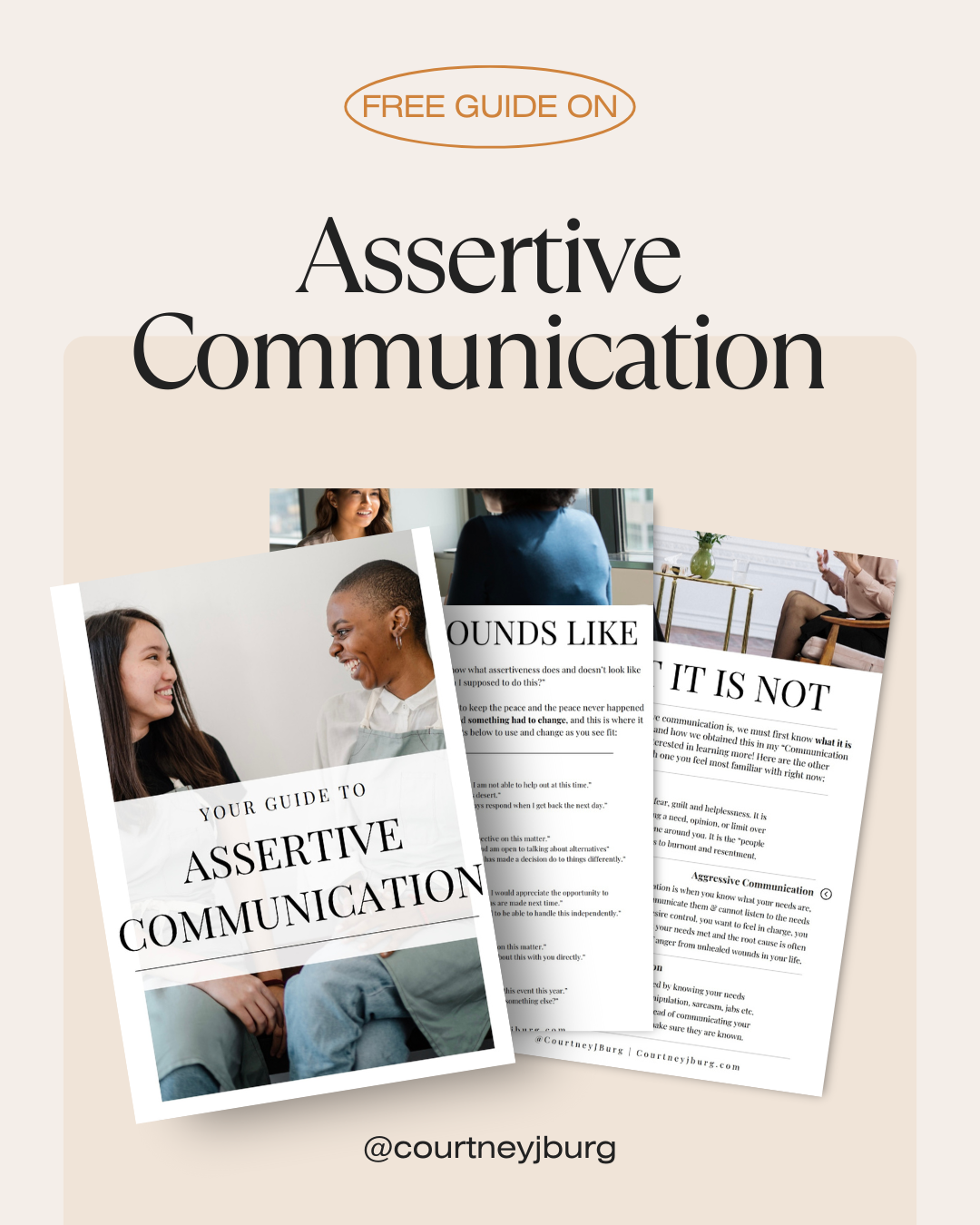
The holidays are quickly approaching, be sure to download my free guide above to help you better communicate. And if you need a refresher on healthy God honoring boundaries, my book is on sale. Check it out HERE!
-CJB
